Home
Class 11
PHYSICS
Calculate the maximum possible value of ...

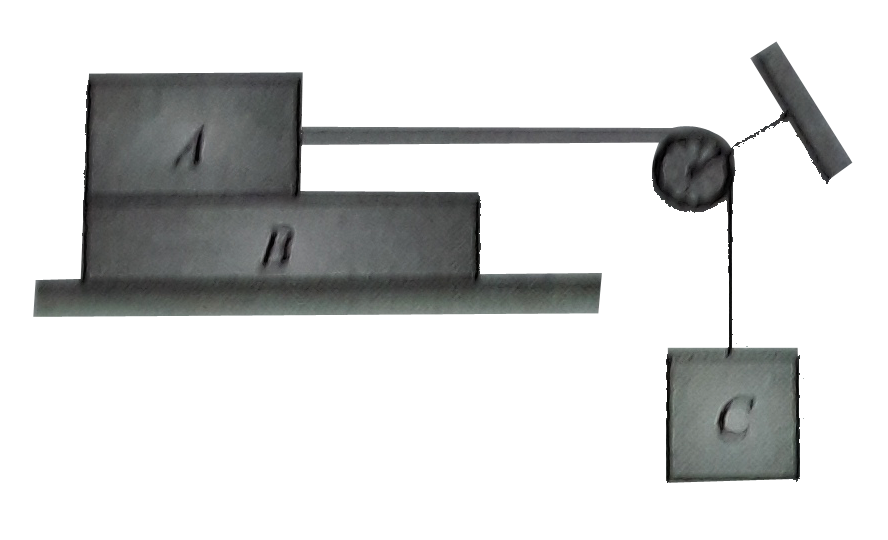
Calculate the maximum possible value of mass `m_(0)` of block C upto which blockA will remain stationary relative to B .If the length of block B is equal to `l = 50 cm` and mass of block C is `m_(3) = 2m_(0)` then calculate the time l when block A will topple from block B .If the system is released from rest

Text Solution

Verified by Experts

The correct Answer is:
`1 kg 0.6s`

Since the seurface beneth the block B is smooth , therefore the block B will move to right
Since A remain stationary relative to B therefore acceleration of A and B are identical, let it be a, hence acceleration of block C will also be equal to a but vertically downward
Since A has the tendency to slip to the right over the surface of B hence friction on A will act leftward and on block B rightward
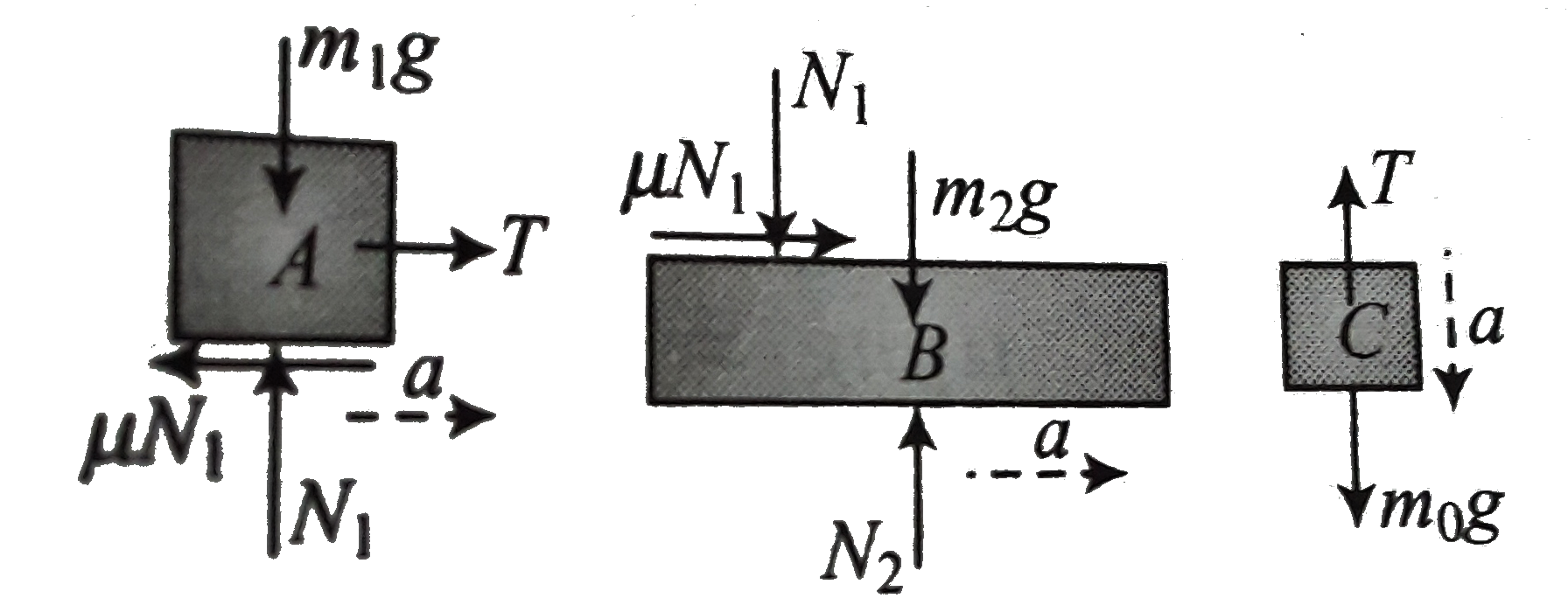
Maximum possible value of mass `m_(A)` of block C will correspond to limiting friction between block B and C hence FBD will be as shown in figure

For vertical equilibrium of A` N_(1) = m_(1)g `
or `N_(1) = 10 N`
For horizontal forces on A
`T - mu N = m_(1) a rArr T = (a + (20)/(3))`
For horizontal forces on B `mu N_(1) = m_(2)a`
`a= (5)/(2) ms^(-2) rArr T = a + (20)/(3) = (25)/(3) `
For force on `C, m_(0)g - T = m_(0).a` or `m_(0) = 1 kg` if mass of blocks C equal to `m_(3) = 2m_(2) g` or `2 kg, A` will slip over the surface at B it mean acceleration of A will be greater than that of B let acceleration of block A be a then acceleration of c will also be equal to a but vertically downward and lot acceleration of block B be b (rightward)
Now FBD will be as shown in figure
For block A
`N_(1) = m_(2)g or N_(1) = 10 N`
`T = mu N_(1) = m_(1) a rArr f = ((a + 20)/(3))`...(i)
For block B `muN_(1) = m_(2)b or b = 5//3 ms^(-2)`
for block C `m_(3)g - T = m_(3)g`...(ii)
from Eqs (i) and (ii)
`T = (100)/(9) N and a = 409 ms^(-2)`
Block A will separate from B other B after through `l = 510 cm` over it .hence considering rightward motion of A retative to B inital velocity `a = 0`
Acceleration `= a - (25)/(9)ms^(-2)`
`s = 50 cm` or `0.50 m t = ?`
Using `v = a + (1)/(2) at^(2) rArr r = 0.6s`
Promotional Banner

Topper's Solved these Questions

  • NEWTON'S LAWS OF MOTION 2

    CENGAGE PHYSICS|Exercise Single Correct|87 Videos
  • NEWTON'S LAWS OF MOTION 2

    CENGAGE PHYSICS|Exercise Multiple Correct|2 Videos
  • NEWTON'S LAWS OF MOTION 2

    CENGAGE PHYSICS|Exercise Exercise 7.3|27 Videos
  • NEWTON'S LAWS OF MOTION 1

    CENGAGE PHYSICS|Exercise Integer|5 Videos
  • PROPERTIES OF SOLIDS AND FLUIDS

    CENGAGE PHYSICS|Exercise INTEGER_TYPE|2 Videos

Similar Questions

Explore conceptually related problems

In the system shown all the surfaces are frictionless while pulley and string are massless. The mass of block A is 2m and that of block B is m. The acceleration of block B immediately after system is released from rest is

In the arrangement shown in the figure (m_(A))/(m_(B))=(2)/(3) and the ratio of density of block B and the liquid is 2:1 The system is released from rest. Then

In the adjoining figure, block A is of mass (m) and block B is of mass2 m. The spring has force constant k. All the surfaces are smooth and the system is released form rest with spring unstretched. .

Given the setup shown in Fig Block A, B and C have masses m_(A)= M and m_(B) =m_(C) = m . The strings are assumed maseless and unstreichable, and the pulleys frictionless .There is no friction between block B and the support table, but there is friction between blocks B and C , denoted by a given coefficient mu a . In terms the given find (i) the acceleration of block A and B b. Suppose the system is released from rest with block C near the right end of block B as shown in the above figure. If the the length L of block B is given, what is the speed of block C as it reached the left end of block B ? Tear the size of C as small c. If the mass of block A is less then some critical value, the blocks will not accelerate when released from rest. Write down as expression for that critical mass.

A horizontal force F acts on the block of mass m and the block remains stationary, thr value of friction force is.

The system shown in figure starts from rest, and each block moves with a constant acceleration. If the relative acceleration of block C with respect to block B is 6m//s^(2) upward and the relative acceleration of block D with respect to block C after 3s from starts.

A block with mass m_(1) is placed on an inclined plane with slope angle alpha and is connected to a second hunging block with mass m_(2) by a cord passing over a small . Friction less pulley as shown in fig 7.247 . The coefficient of static friction is mu_(2) and the coefficient of kinetic friction is mu_(s) a. Find the mass m_(2) for which block m_(1) moves up plane at constant speed once it is set in motion b. Find the mass m_(2) for which block m_(1) moves down the plane at constant speed once it is set in motion c.For what range of m_(2) will the blocks remain at rest if they are released from rest?

Figure-2.54 shows a block of mass m is placed on an inclined wedge of mass M If the system is released from rest find the acceleration of m and M.

The coefficient of friction between the block A of mass m & block B of mass 2m is mu . There is no friction between block B & the inclined plane. If the system of blocks A & B is released from rest & there is no slipping between A & B then :

Three blocks A,B, and C are suspended as shown in fig. Mass of each of blocks A and B is m. If the system is in equilibrium, and mass of C is M then

CENGAGE PHYSICS-NEWTON'S LAWS OF MOTION 2-Subjective
  1. Block A as shown in figure weight 1.40 N and block B weight 4.20 N The...

    Text Solution

    |

  2. Two block , with masses m(1) and m(2) are staked as shown in fig and p...

    Text Solution

    |

  3. Block A has a mass of 30 kg and block B a mass of 15 kg . The coeffici...

    Text Solution

    |

  4. Block A weight 20 kg placed on a smooth surface. Weight B of 2 kg is m...

    Text Solution

    |

  5. In figure find the acceleration of m assuming that there is friction b...

    Text Solution

    |

  6. The masses of the block A and B are m and M Between A and B there is a...

    Text Solution

    |

  7. Two block of masses m and M are connected by a chord passing around a ...

    Text Solution

    |

  8. A block with mass m(1) is placed on an inclined plane with slope angle...

    Text Solution

    |

  9. Consider three blocks placed one over the other as shown in Fig. Let a...

    Text Solution

    |

  10. Four block are arranged on a smooth horizontal surface as shown in fi...

    Text Solution

    |

  11. A block of mass m is pressed against a wall which is moving with an ac...

    Text Solution

    |

  12. In the arrangement shown in figure pulleys are mass of block A,b and C...

    Text Solution

    |

  13. In the arrangement shown in figure mass of blocks A,B and C is 18.5 kg...

    Text Solution

    |

  14. A cubical block is experiencing three forces F(1) = 20 N acts at angle...

    Text Solution

    |

  15. A block of mass m = 3 kg is resting over a rough horizontal surface ha...

    Text Solution

    |

  16. The mass of the wedge shown in fig is M = 4 kg and that of block is m...

    Text Solution

    |

  17. Calculate the maximum possible value of mass m(0) of block C upto whic...

    Text Solution

    |

  18. With two hands you hold a cone motionless upside doen , as shown in fi...

    Text Solution

    |

  19. A prismatic block of mass m is kept on a groove . The bottom line of t...

    Text Solution

    |

  20. A block of mass m(1) connected with another of mass m(2) by a light s...

    Text Solution

    |

