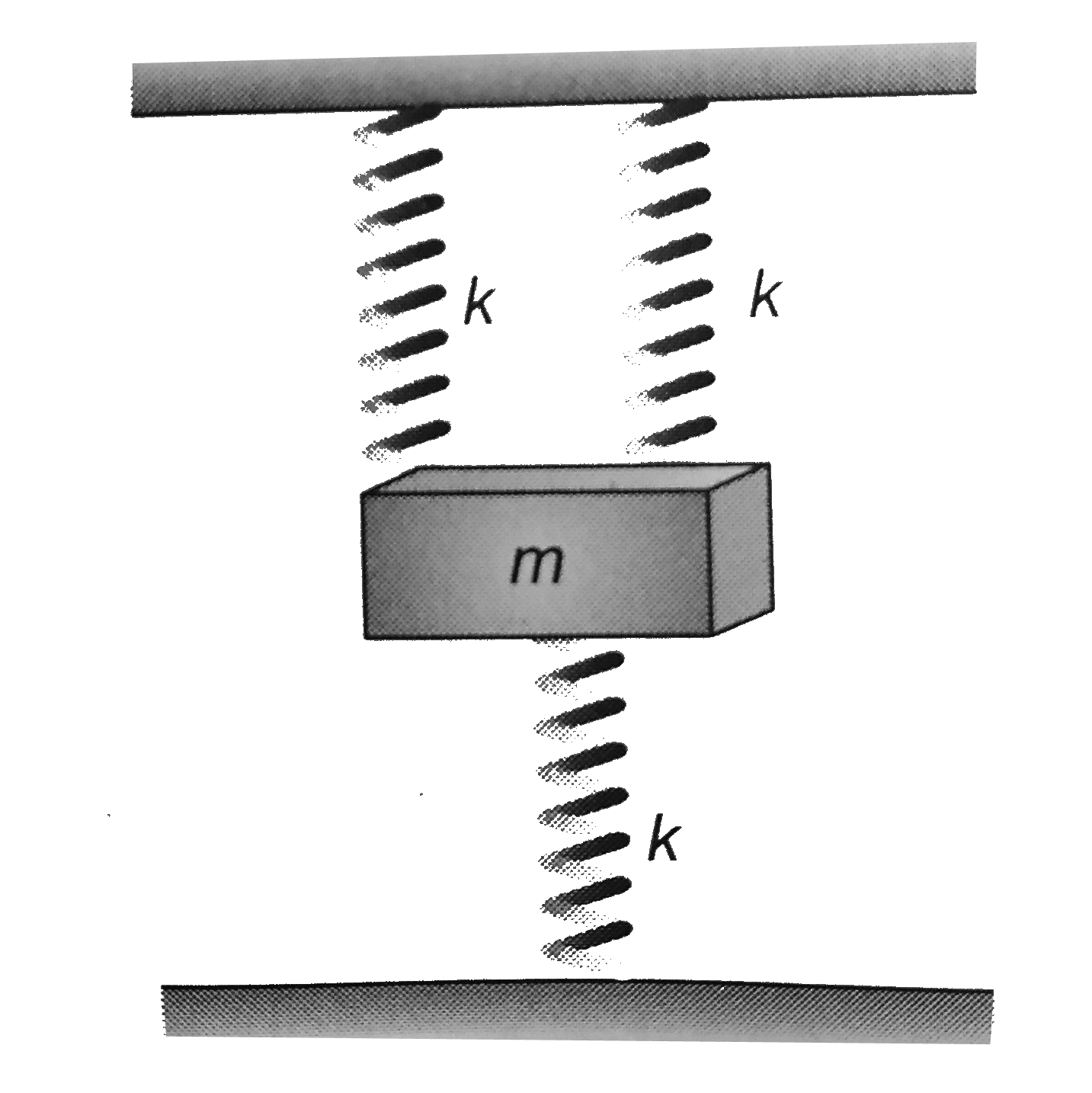
A
B
C
D
Text Solution
Verified by Experts
The correct Answer is:



Topper's Solved these Questions
OSCILLATION AND SIMPLE HARMONIC MOTION
A2Z|Exercise Simple Pendulum And Different Cases Of Shm|25 VideosOSCILLATION AND SIMPLE HARMONIC MOTION
A2Z|Exercise Superposition Of Shm And Compound Pendulum|19 VideosOSCILLATION AND SIMPLE HARMONIC MOTION
A2Z|Exercise Velocity , Acceleration And Energy Of Simple Harmonic Motion|40 VideosNEWTONS LAWS OF MOTION
A2Z|Exercise Chapter Test|30 VideosPROPERTIES OF MATTER
A2Z|Exercise Chapter Test|29 Videos
Similar Questions
Explore conceptually related problems
A2Z-OSCILLATION AND SIMPLE HARMONIC MOTION-Spring Particle System
- Time period of a block when suspended from the upper plate of a parall...
Text Solution
|
- Two identical particle each of mass m are inter connects by a light sp...
Text Solution
|
- In figure S(1) andS(1) are identical springs. The oscillation frequenc...
Text Solution
|
- One end of a spring of force constant k is fixed to a vertical wall an...
Text Solution
|
- Three masses 700g and 500g and 400g are suspended at the end of a spri...
Text Solution
|
- Four massless spring whose force constant are 2k , 2k, k and 2k respec...
Text Solution
|
- A particle at the end of a spring executes S.H,M with a period t(1)whi...
Text Solution
|
- Two identical spring are attached to a small block P The other ends of...
Text Solution
|
- Figure shows a system consisting of a massless pulley, a spring of for...
Text Solution
|
- A block of mass m is at rest on an another block of same mass as shown...
Text Solution
|
- Two particles (A) and (B) of equal masses are suspended from two massl...
Text Solution
|
- In the figure all spring are identical having spring constant k and ma...
Text Solution
|
- In the figure shown a block of masss m is atteched at ends of two spri...
Text Solution
|
- A force of 6.4N stretched a vertical spring by 0.1m .The mass that mus...
Text Solution
|
- A system is shown in the figure. The force The time period for small ...
Text Solution
|
- A block of mass m length force a verical of spring constant k If the b...
Text Solution
|
- A mass (M) is suspended from a spring of negligible mass. The spring i...
Text Solution
|
- A spring of spring constant K is cut equal parts of which t part are p...
Text Solution
|
- In a horizontal spring - mass m is released after being displaced tow...
Text Solution
|
- In the previous question, the amplitude of the oscillation is
Text Solution
|