Home
Class 12
MATHS
Consider point P(x, y) in first quadrant...

Consider point P(x, y) in first quadrant. Its reflection about x-axis is `Q(x_(1), y_(1))`. So, `x_(1)=x` and `y(1)=-y`.
This may be written as : `{(x_(1)=1. x+0.y),(y_(1)=0. x+(-1)y):}`
This system of equations can be put in the matrix as :
`[(x_(1)),(y_(1))]=[(1,0),(0,-1)][(x),(y)]`
Here, matrix `[(1,0),(0,-1)]` is the matrix of reflection about x-axis. Then find the matrix of reflection about the line `y=x`.

Text Solution

Verified by Experts
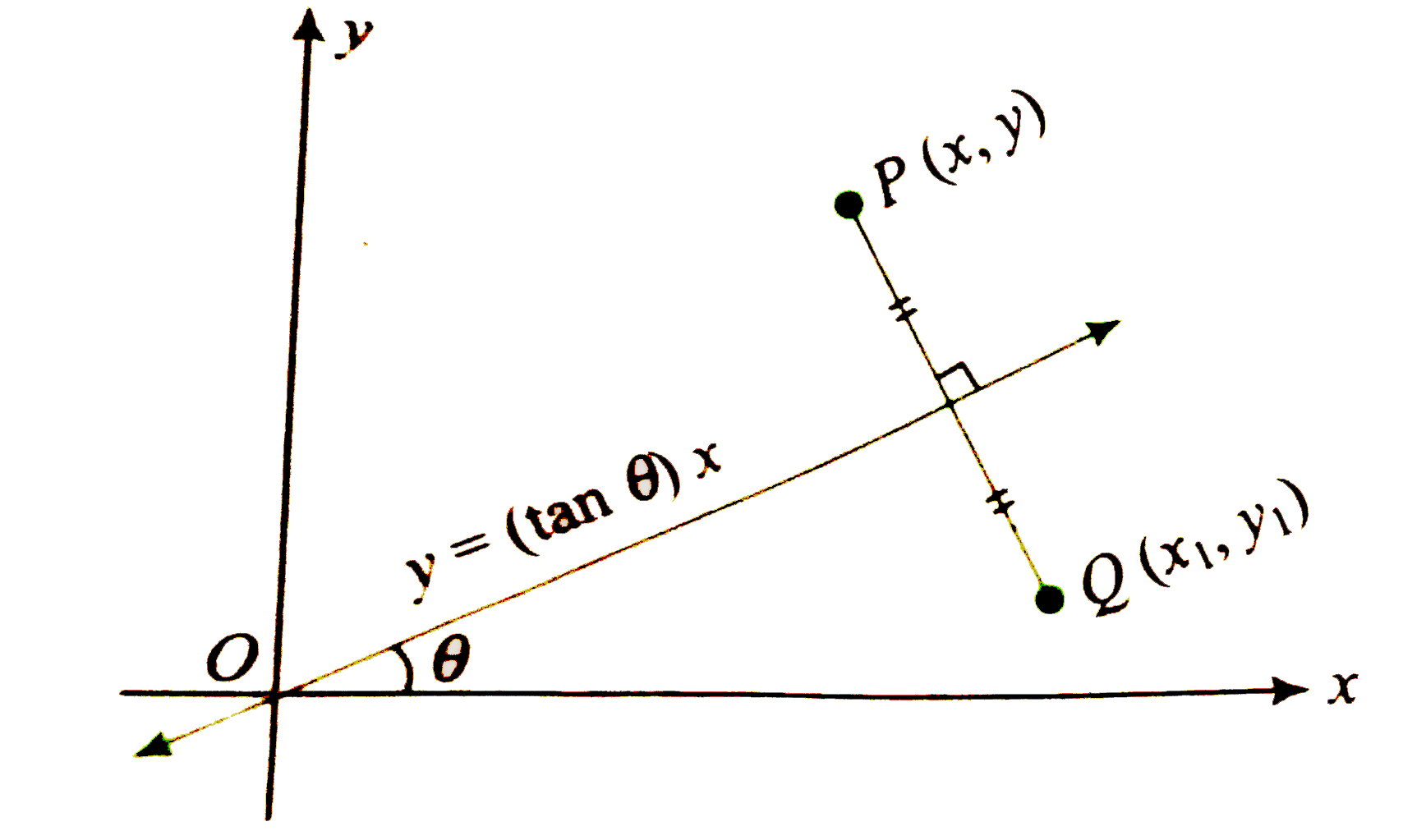
(i) Reflection of (x, y) about y-axis is `(x_(1), y_(1)) equiv (-x, y)`.
`:. x_(1)=(-1)x+0y`
and `y_(1)=0x+y`
`:. [(x_(1)),(y_(1))]=[(-1,0),(0,1)][(x),(y)]`
(ii) Reflection of (x, y) about the line `y=x` is `(x_(1), y_(1)) equiv (y, x)`.
`:. x_(1)=0x+y`
`y_(1)=x+0y`
`:. [(x_(1)),(y_(1))]=[(0,1),(1,0)][(x),(y)]`
(iii) Reflection of (x, y) about origin is `(x_(1), y_(1)) equiv (-x, -y)`.
`:. x_(1)=-x+0y`
`y_(1)=0x-y`
`:. [(x_(1)),(y_(1))]=[(-1,0),(0,-1)][(x),(y)]`
(iv) Reflecton in line `t=x tan theta` or `(sin theta)x-(cos theta)y=0`:

We kanow that
`(x_(1)-x)/(sin theta)=(y_(1)-y)/(- cos theta)=(-2((sin theta)x-(cos theta)y))/(sin^(2) theta+cos^(2) theta)`
`:. x_(1)=(1-2 sin^(2) theta)x+(2 sin theta cos theta)y`
or `x_(1)=(cos 2 theta)x+(sin 2 theta) y`
`y_(1)=(2 sin theta cos theta)x+ (1-2 cos^(2) theta)y`
or `y_(1)=(sin 2 theta)x-(cos 2 theta)y`
Thus, `[(x_(1)),(y_(1))]=[(cos 2 theta,sin 2 theta),(sin 2 theta,- cos 2 theta)][(x),(y)]`
By putting `theta=0, pi//2, pi//4`, we can get the reflection matrices x-axis, y-axis and the line y=x, respectively.
Promotional Banner

Topper's Solved these Questions

  • MATRICES

    CENGAGE ENGLISH|Exercise CAE 13.1|5 Videos
  • MATRICES

    CENGAGE ENGLISH|Exercise CAE 13.2|6 Videos
  • MATRICES

    CENGAGE ENGLISH|Exercise Single correct Answer|34 Videos
  • MATHMETICAL REASONING

    CENGAGE ENGLISH|Exercise Archives|10 Videos
  • METHODS OF DIFFERENTIATION

    CENGAGE ENGLISH|Exercise Single Correct Answer Type|46 Videos

Similar Questions

Explore conceptually related problems

The matrix [(0,1),(1,0)] is the matrix of reflection in the line (A) x-y=0 (B) x+y=0 (C) x-y=1 (D) x+y=1

The matrix of the transformation reflection in the line x+y=0 is (A) [(-1,0),(0,-1)] (B) [(1,0),(0,-1)] (C) [(0,1),(1,0)] (D) [(0,-1),(-1,0)]

Find the equations of the diagonals of the square formed by the lines x=0,y=0,x=1 and y=1.

Equations of diagonals of the square formed by the lines x=0,y=0,x=1 and y=1 are

Point P(x, y) is rotated by an angle theta in anticlockwise direction. The new position of point P is Q (x_(1), y_(1)) . If [(x_(1)),(y_(1))]=A[(x),(y)] , then find matrix A.

If (x_(0), y_(0), z_(0)) is any solution of the system of equations 2x-y-z=1, -x-y+2z=1 and x-2y+z=2 , then the value of (x_(0)^(2)-y_(0)^(2)+1)/(z_(0)) (where, z_(0) ne 0 ) is

If [[(x+3y),y],[7-x,4]]=[(4,-1),(0,1)], find the values of x and y.

If matrix A=[{:(1,-4),(3,0):}] is express as a sum of symmetric and skew symmetric matrices as [{:(1,x),(-(1)/(2),0):}]+[{:(0,-(7)/(2)),(y,0):}] then x+y=?

Find the values of x and y from each of the following matrix equation : (i) [{:(x+y),(x-y):}]=[(3)/(1)](ii) [{:(x+y,7),(0,2x):}]=[{:(-1,7),(0,6):}]

Find x ,\ y satisfying the matrix equations: x[2 1]+y[3 5]+[-8-11]=0

CENGAGE ENGLISH-MATRICES-ILLUSTRATION
  1. Given a matrix A=[a b c b c a c a b],w h e r ea ,b ,c are real positiv...

    Text Solution

    |

  2. If M is a 3xx3 matrix, where det M=1a n dM M^T=1,w h e r eI is an iden...

    Text Solution

    |

  3. Consider point P(x, y) in first quadrant. Its reflection about x-axis ...

    Text Solution

    |

  4. If A=[[2,-2,-4],[-1,3,4],[1,-2,-3]] then A is 1) an idempotent matrix ...

    Text Solution

    |

  5. If A= [(1,1,3),(5,2,6),(-2,-1,-3)] then find A^(14)+3A-2I

    Text Solution

    |

  6. The matrix A=[-5-8 0 3 5 0 1 2-] is a. idempotent matrix b. involut...

    Text Solution

    |

  7. If abc=p and A=[(a,b,c),(c,a,b),(b,c,a)], prove that A is orthogonal i...

    Text Solution

    |

  8. Let A be an orthogonal matrix, and B is a matrix such that AB=BA, then...

    Text Solution

    |

  9. Find the adjoint of the matrix A=[(1,1,1),(2,1,-3),(-1,2,3)].

    Text Solution

    |

  10. If S=[((sqrt(3)-1)/(2sqrt(2)),(sqrt(3)+1)/(2sqrt(2))),(-((sqrt(3)+1)/(...

    Text Solution

    |

  11. If A is a square matrix such that A(adjA)=[(4,0,0),(0,4,0),(0,0,4)], t...

    Text Solution

    |

  12. Let A be a square matrix of order 3 such that adj. (adj. (adj. A)) =...

    Text Solution

    |

  13. Let A =[(1,-1,1),(2,1,-3),(1,1,1)] and 10B=[(4,2,2),(-5,0,alpha),(...

    Text Solution

    |

  14. Matrices a and B satisfy AB=B^(-1), where B=[(2,-1),(2,0)]. Find (i...

    Text Solution

    |

  15. Given the matrices A and B as A=[(1,-1),(4,-1)] and B=[(1,-1),(2,-2)]....

    Text Solution

    |

  16. If M is the matrix [(1,-3),(-1,1)] then find matrix sum(r=0)^(oo) ((-1...

    Text Solution

    |

  17. Let p be a non singular matrix, and I + P + p^2 + ... + p^n = 0, then ...

    Text Solution

    |

  18. If A and B are square matrices of same order such that AB=O and B ne O...

    Text Solution

    |

  19. If A is a symmetric matrix, B is a skew-symmetric matrix, A+B is nonsi...

    Text Solution

    |

  20. If the matrices, A, B and (A+B) are non-singular, then prove that [A(A...

    Text Solution

    |

