Home
Class 12
MATHS
The pressure-volume of various thermodyn...

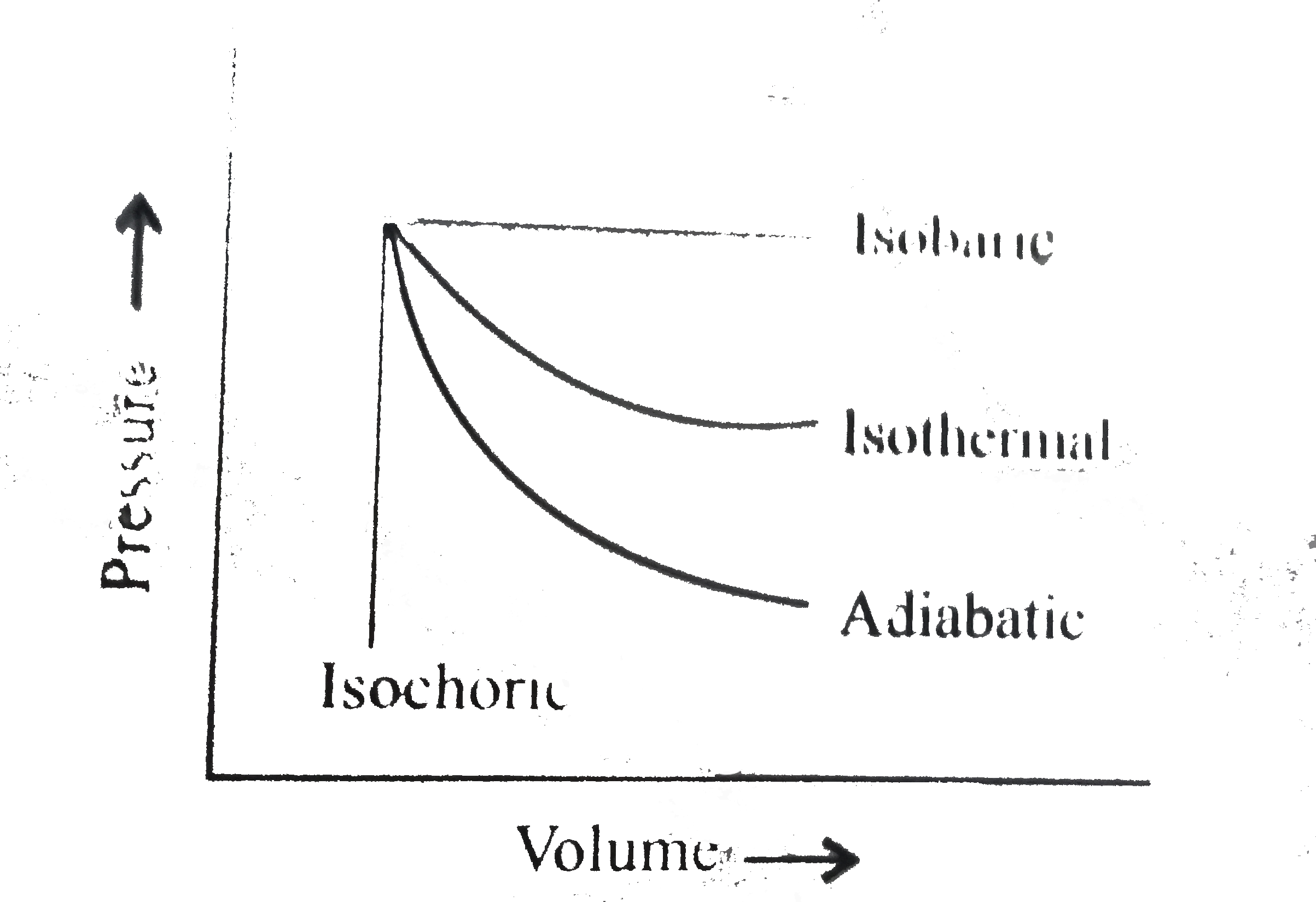
The pressure-volume of various thermodynamic process is shown in graphs:

Work is the mole of transference of energy. It has been observed that reversible work done by the system is the maximum obtainable work.
`w_(rev) gt w_(irr)`
The works of isothermal and adiabatic processes are different from each other.
`w_("isothermal reversible") = 2.303 nRT log_(10) ((V_(2))/(V_(1)))`
`= 2.303 nRT log_(10)((P_(2))/(P_(1)))`
`w_("adiabatic reversible") = C_(V) (T_(1)-T_(2))`
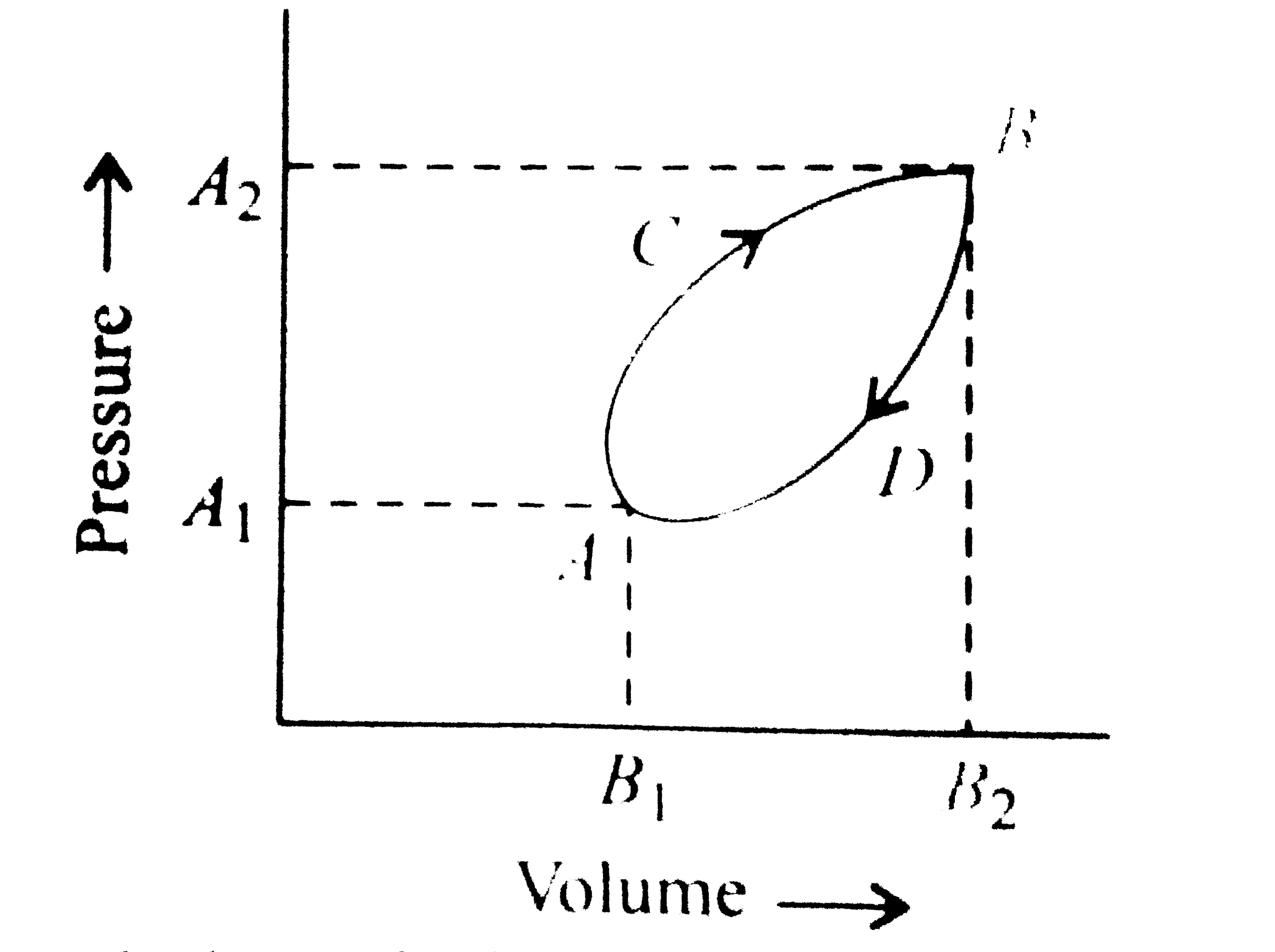
A thermodynamic system goes in a cyclic process as represented in the following `P -V` diagram:

The net work done during the complete cycle is given by the area

A

|z|=5

B

|z|lt 5

C

|z| gt5

D

2 lt |z| lt 3

Text Solution

Verified by Experts

The correct Answer is:

B, D
Promotional Banner

Topper's Solved these Questions

  • COMPLEX NUMBERS AND QUADRATIC EQUATIONS

    AAKASH INSTITUTE ENGLISH|Exercise Assignment (Section -D) Linked comprehension Type Questions|14 Videos
  • COMPLEX NUMBERS AND QUADRATIC EQUATIONS

    AAKASH INSTITUTE ENGLISH|Exercise Assertion -Reason Type Questions|19 Videos
  • COMPLEX NUMBERS AND QUADRATIC EQUATIONS

    AAKASH INSTITUTE ENGLISH|Exercise Assignment (Section -B) (objective Type Questions ( one option is correct)|78 Videos
  • BINOMIAL THEOREM

    AAKASH INSTITUTE ENGLISH|Exercise Assignment (section-J) Objective type question (Aakash Challengers Questions)|4 Videos
  • CONIC SECTIONS

    AAKASH INSTITUTE ENGLISH|Exercise SECTION - J ( Aakash Challengers Questions )|16 Videos

Similar Questions

Explore conceptually related problems

The pressure-volume of varies thermodynamic process is shown in graphs: Work is the mole of transference of energy. It has been observed that reversible work done by the system is the maximum obtainable work. w_(rev) gt w_(irr) The works of isothermal and adiabatic processes are different from each other. w_("isothermal reversible") = 2.303 nRT log_(10) ((V_(2))/(V_(1))) = 2.303 nRT log_(10)((P_(2))/(P_(1))) w_("adiabatic reversible") = C_(V) (T_(1)-T_(2)) A thermodynamic system goes in a cyclic process as represented in the following P -V diagram: The network done during the complete cycle is given by the area

The pressure-volume of varies thermodynamic process is shown in graphs: Work is the mole of transference of energy. It has been observed that reversible work done by the system is the maximum obtainable work. w_(rev) gt w_(irr) The works of isothermal and adiabatic processes are different from each other. w_("isothermal reversible") = 2.303 nRT log_(10) ((V_(2))/(V_(1))) = 2.303 nRT log_(10)((P_(2))/(P_(1))) w_("adiabatic reversible") = C_(V) (T_(1)-T_(2)) P-V plots for two gases during adiabatic processes are given in the given figure: Plot D and Plot C should correspond to

The pressure-volume of varies thermodynamic process is shown in graphs: Work is the mole of transference of energy. It has been observed that reversible work done by the system is the maximum obtainable work. w_(rev) gt w_(irr) The works of isothermal and adiabatic processes are different from each other. w_("isothermal reversible") = - 2.303 nRT log_(10) ((V_(2))/(V_(1))) = 2.303 nRT log_(10)((P_(2))/(P_(1))) w_("adiabatic reversible") = C_(V) (T_(1)-T_(2)) Calculate work done when 1 mole of an ideal gas is expanded reversibly from 30L to 60L at a constant temperature of 300K

The pressure-volume of varies thermodynamic process is shown in graphs: Work is the mole of transference of energy. It has been observed that reversible work done by the system is the maximum obtainable work. w_(rev) gt w_(irr) The works of isothermal and adiabatic processes are different from each other. w_("isothermal reversible") = 2.303 nRT log_(10) ((V_(2))/(V_(1))) = 2.303 nRT log_(10)((P_(2))/(P_(1))) w_("adiabatic reversible") = C_(V) (T_(1)-T_(2)) If w_(1),w_(2),w_(3) and w_(4) are work done in isothermal, adiabatic, isobaric, and isochoric reversible processes, respectively then the correct sequence (for expansion) would be

The pressure-volume of varies thermodynamic process is shown in graphs: Work is the mole of transference of energy. It has been observed that reversible work done by the system is the maximum obtainable work. w_(rev) gt w_(irr) The works of isothermal and adiabatic processes are different from each other. w_("isothermal reversible") = 2.303 nRT log_(10) ((V_(2))/(V_(1))) = 2.303 nRT log_(10)((P_(2))/(P_(1))) w_("adiabatic reversible") = C_(V) (T_(1)-T_(2)) The q value and work done in isothermal reversible expansion of one mole of an ideal gas from initial pressure of 1 bar to final pressure of 0.1 bar at constant temperature 273K are:

if work is done by the system then W is

P – V graph for a cyclic process is shown in figure . Work done is given by

The work done by 1 mole of ideal gas during an adiabatic process is (are ) given by :

Work done in reversible isothermal expansion is given by

A thermodynamic system goes from states (i) P_(1),V to 2P_(1),V (ii) P,V_(1) to P2 ,V_(1) . Then work done in the two cases is

AAKASH INSTITUTE ENGLISH-COMPLEX NUMBERS AND QUADRATIC EQUATIONS-Assignment (Section -C) (objective Type Questions ( more thena one options are correct )
  1. If root3(-1) = -1 , -omega, -omega^(2) , then roots of the equation ...

    Text Solution

    |

  2. If z(1)=p+iq and z(2) = u = iv are complex numbers such that |z(1)|=...

    Text Solution

    |

  3. The pressure-volume of various thermodynamic process is shown in graph...

    Text Solution

    |

  4. If z(1) ,z(2) be two complex numbers satisfying the equation |(z(1)...

    Text Solution

    |

  5. If sin alpha, cosalpha are the roots of the equation x^2 + bx + c = 0 ...

    Text Solution

    |

  6. If alpha, beta are the roots of the equation ax^(2) +2bx +c =0 and a...

    Text Solution

    |

  7. The solution set of the inequality (x+3)^(5) -(x -1)^(5) ge 244 is

    Text Solution

    |

  8. Let a,b,c be real numbers in G.P. such that a and c are positive , the...

    Text Solution

    |

  9. Let cos alpha be a root of the equation 25x^(2) +5x -12 = 0 -1 lt x...

    Text Solution

    |

  10. If the quadratic equations x^(2) +pqx +r=0 and z^(2) +prx +q=0 have a...

    Text Solution

    |

  11. The quadratic equation x^(2) - (m -3)x + m =0 has

    Text Solution

    |

  12. If both roots of the equation x^(2) -2ax+a^(2)-1=0 lie between -3 and...

    Text Solution

    |

  13. Let alpha, beta " the roots of " x^(2) -4x + A =0 and gamma, delta " ...

    Text Solution

    |

  14. For the equation x^(3/4(logx)^(2)+log(2)x-5/4)=sqrt2, which one of the...

    Text Solution

    |

  15. If f(x)=a x^2+b x+c ,g(x)=-a x^2+b x+c ,where ac!=0, then prove that f...

    Text Solution

    |

  16. Sum of the squares of all integral values of a for which the inequalit...

    Text Solution

    |

  17. If the roots of the equation 1/(x+p) + 1/(x+q) = 1/r are equal in mag...

    Text Solution

    |

  18. Find the integral values of a for which (a+2)x^2+2(a+1)x+a=0 will have...

    Text Solution

    |

  19. If (x-1)^(2) is a factor of ax^(3) +bx^(2) +c then roots of the equa...

    Text Solution

    |

  20. If b^(2)ge4ac for the equation ax^(4)+bx^(2)+c=0 then all the roots of...

    Text Solution

    |
